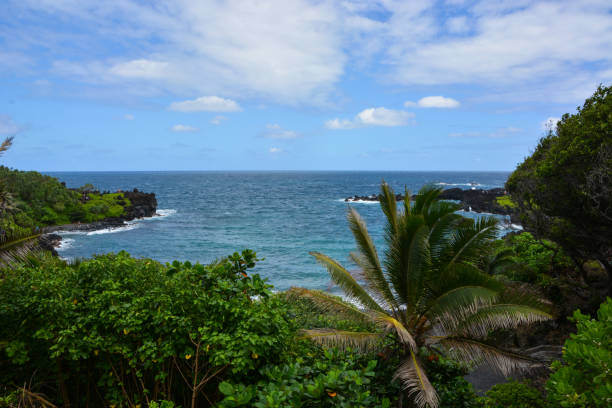
For many travelers, Hana Town feels like the finish line of the legendary Road to Hana. They celebrate with banana bread, dip their toes in Hana Bay, and turn the car around, exhausted and satisfied. Yet just beyond town, where the highway narrows and the rainforest presses closer, lies Kipahulu, a place that rewards those willing to continue a little farther. This district of Haleakala National Park protects a dramatic coastline, ancient Hawaiian sites, freshwater pools, and the famous Pipiwai Trail. If Hana is the heart of East Maui, Kipahulu is its wild, sacred edge.
The drive from Hana to Kipahulu is short in miles but rich in scenery. The road curls past hidden coves, lava-rock beaches, and pastures where horses stand against a backdrop of ocean. You may pass Palapala Ho’omau Church, a quiet seaside sanctuary where aviator Charles Lindbergh was buried. The gravesite is simple, peaceful, and easy to miss if you are rushing. This stretch of road asks for patience, not speed, and the rewards come in glimpses: a waterfall threads down a green cliff, a surfer checks the break at a lonely shore, a cluster of wild ginger perfumes the air.
At the end of the road is the Kipahulu District and Ohe’o Gulch, often called the Seven Sacred Pools. The name is a marketing invention, and it does not capture what makes this place powerful. The pools are part of a living stream system that can rise without warning. When conditions are safe, visitors can walk the Kuloa Point Trail, a gentle loop that offers views of the pools, the ocean, and archaeological remains. When the water is high or the forecast uncertain, the pools close, and that closure is not a disappointment. It is a reminder that nature here is not a theme park. Flash floods have swept people away. The best visit is a respectful one.
Above the pools, the Pipiwai Trail climbs into another world. The trail is roughly four miles round trip, with elevation gain and mud that can make it feel longer. It passes an enormous banyan tree, its aerial roots hanging like curtains, then reaches Makahiku Falls, a ribbon of white in the forest. But the trail’s most unforgettable section is the bamboo forest. The path becomes a boardwalk through towering green stalks that click and creak in the wind. Light filters down in soft, emerald beams. It feels like walking through a natural cathedral, and most people fall silent without being asked. At the end, Waimoku Falls drops more than 400 feet down a sheer rock wall, a final reward that is worth every slippery step.
Kipahulu is also a place of deep Hawaiian history. Before it became a national park, this area supported thriving communities. Ancient Hawaiians cultivated taro in the valleys, fished the coastline, and built temples. Some of those stone remnants remain. Visitors should stay on trails and never move or take artifacts. The land is not simply scenery; it is ancestry. Understanding that changes the way you see the pools, the ocean, and the bamboo.
Planning a trip to Kipahulu takes some care. Start early, because the Road to Hana is slow and daylight fades quickly. Check the National Park Service website or call ahead for closures and weather. Wear shoes with traction, bring water and snacks, and pack rain gear even if the sky is blue. Cell service is unreliable, so download maps before you go. Fill your gas tank in Paia or Hana. If you can, stay overnight in Hana or nearby rather than driving the entire road back in one day. That extra time lets you enjoy Kipahulu without watching the clock.
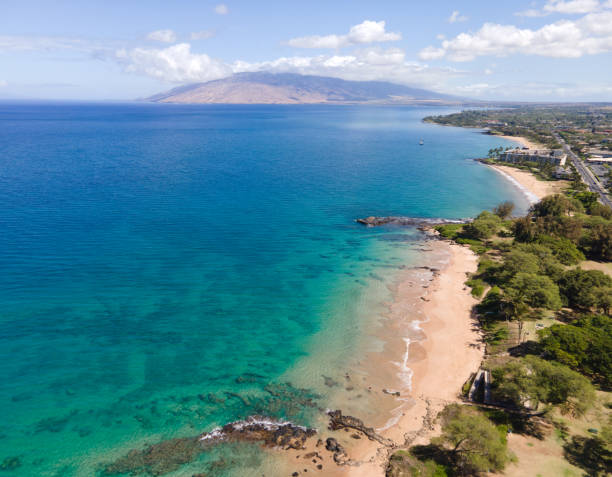
Many people dream of Maui’s beaches and resorts, and those are wonderful. But Kipahulu offers something different: a chance to stand at the edge of a wild island, where freshwater meets salt, where history lives in stone, and where a bamboo forest hums in the breeze. It is not the easiest place to reach, and that is part of its magic. Go slowly, go humbly, and let Kipahulu be more than a stop on the Road to Hana. Let it be the memory you carry home.