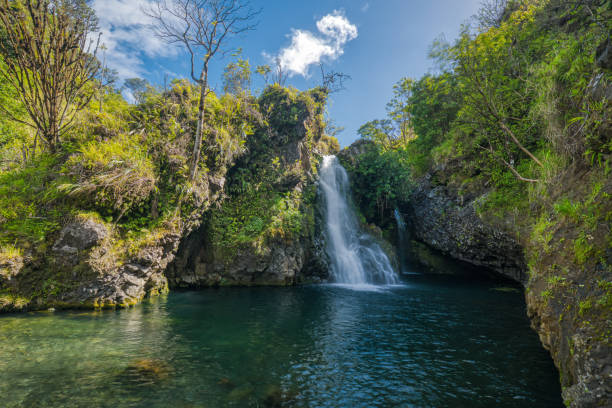
The Road to Hana is famous for its curves, one-lane bridges, and lush scenery, but for many travelers the real magic begins when the car stops and the hiking shoes come out. This windward coast of Maui is a living rainforest, where mist clings to the valleys and water tumbles down lava cliffs in ribbons and sheets. Every mile seems to hide another cascade, another bamboo grove, another chance to stand beneath a canopy of giant ferns and listen to the island breathe. Hiking here asks for patience, respect, and a willingness to get muddy, but the reward is a side of Maui that feels raw, ancient, and unforgettable.
Start early, ideally before sunrise, because the road is slow, parking is limited, and afternoon rain can turn a gentle stream into a dangerous torrent. Twin Falls, near mile marker two, is often the first stop. It offers a relatively easy walk to several pools and falls, plus a fruit stand that makes a fine breakfast. Yet even here, caution matters. If the water is brown, rising, or carrying debris, stay on the bank. Heavy rain upstream can send a flash flood through a calm-looking pool within minutes, and the mountain weather may be completely different from the sunny coast.
Farther along, Waikamoi Ridge Trail provides a quieter leg stretch through eucalyptus and bamboo, with ridge views when clouds lift. The trail can be slick, but it is a lovely introduction to the forest without committing to a long hike. At Upper Waikani Falls, often called Three Bears, the falls spill beside the road in three distinct strands. Parking is tight and the shoulder is narrow, so never block traffic or private driveways. The short path down to the pool is steep and rocky, and after rain it becomes a slippery scramble. Sometimes the wisest choice is to admire the falls from the bridge and continue. Pua’a Ka’a State Wayside offers another accessible stop, with small waterfalls, picnic tables, and restrooms, while Wailua Falls near Hana delivers a dramatic roadside cascade that photographers love.
The crown jewel for many hikers is the Pipiwai Trail in Haleakala National Park’s Kipahulu District, beyond Hana. This four-mile round-trip climb gains about eight hundred feet and passes Makahiku Falls before entering a cathedral-like bamboo forest. The sound of bamboo knocking in the wind is worth the trip by itself. The trail ends at Waimoku Falls, a four-hundred-foot ribbon of water dropping down a sheer rock wall. The final stretch can be muddy and root-covered, so sturdy shoes are essential. Swimming at the base is not recommended because rocks can fall without warning. Below the trail, the pools of Ohe’o Gulch, sometimes called the Seven Sacred Pools, are beautiful but subject to closures. Always check park conditions and never ignore a closed gate or warning sign.
Practical preparation makes the difference between a miserable slog and a memorable adventure. Bring more water than you think you need, along with snacks, insect repellent, a rain jacket, and a dry bag for electronics. Wear shoes with real traction; flip-flops belong at the beach, not on a rainforest trail. Cell service is unreliable, so download maps ahead of time or carry a paper guide. Drive with aloha by yielding on one-lane bridges and pulling over for local traffic. Pack out everything you bring in, including fruit peels and wrappers, and leave rocks, flowers, and shells where they belong. Freshwater streams can carry leptospirosis, so avoid swallowing water and cover open cuts. Never dive into an unfamiliar pool, and never tie ropes to trees or rocks for swinging.
The Road to Hana waterfalls are not a checklist to conquer. They are living parts of a watershed that nourishes the island. Some days they roar; other days they disappear into mist. Hiking here teaches you to slow down, to notice the tiny red berries beside the trail, the smell of ginger and guava, the cool breath of a cave behind a fall. If you can, stay overnight in Hana or Kipahulu so you are not racing back in the dark. Give yourself a full day, or better, two. The best moments often happen when you stop trying to see everything and simply stand still. In that stillness, Maui’s rainforest reveals itself: wild, delicate, powerful, and utterly alive.