At dawn, when the sky turns from ink to rose and the crater floor begins to glow, Haleakala feels less like a mountain and more like another world. The name means “house of the sun,” and from the summit at 10,023 feet, you understand why ancient Hawaiians told stories of Maui capturing the sun here. But the real magic for hikers is not only the view from above. It is what happens when you step onto the trail and descend into the vast, quiet basin of Haleakala Crater. This is not a traditional crater with a single rim and a flat bottom. It is a broad erosional valley shaped by wind, rain, and time, filled with cinder cones, lava flows, and silverswords. Hiking here is a high-altitude adventure that rewards preparation and patience.
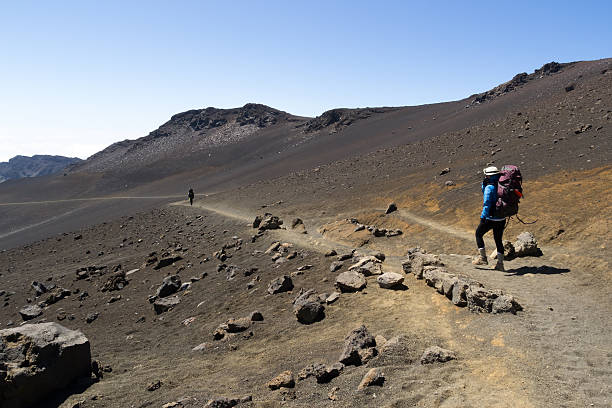
Most crater hikes begin at the summit area near the Visitor Center. The most famous route is Sliding Sands Trail, also called Keonehe‘ehe‘e. It starts at roughly 9,740 feet and drops about 2,500 feet over four miles to the crater floor. The name is perfect. The trail is made of loose volcanic cinder and ash, so each step slides slightly, especially on the descent. Downhill feels easy at first, but that is a trap. The return climb is steep, and the air holds far less oxygen than at sea level. Even fit hikers should turn around before they feel exhausted. A short walk to the first overlook offers incredible views without committing to the full descent.
For a different approach, the Halemau‘u Trail begins lower, around 8,000 feet, and descends a dramatic cliff face with switchbacks. It meets the crater floor near Holua Cabin and connects with trails that cross the basin. Many experienced hikers combine Sliding Sands and Halemau‘u into a traverse, descending one trail, crossing the crater, and exiting the other. This requires a shuttle or two vehicles, and it makes for a long, demanding day. The reward is a journey through a landscape that changes with every mile: black cinder, red ash, gray lava, and golden grass.
Overnight trips turn the crater into a deeper experience. The National Park Service manages wilderness cabins at Holua, Kapalaoa, and Paliku, and there are campsites as well. Permits are required and reservations can be extremely competitive, often booked months in advance. If you secure one, you will fall asleep under some of the clearest skies on Earth and wake to a sunrise that feels private and profound. Without a permit, plan a day hike only and carry more water than you think you need. There is no potable water along the crater trails, and any catchment tank supply must be treated before drinking.
Weather in Haleakala is famously unpredictable. A sunny morning at the summit can become cold, windy, and wet within an hour. Temperatures can drop near freezing, and strong winds make it feel colder. Bring layers, a rain shell, a hat, gloves, sunscreen, and sunglasses. The high altitude also means you should hydrate constantly and eat snacks even if you are not hungry. If you feel a headache, dizziness, or nausea, descend immediately. Altitude sickness is real and can affect anyone, regardless of fitness. The crater floor can feel hot at midday and near freezing after dark, so do not judge conditions by the beach below.
The crater is a fragile place. Silverswords, or ‘ahinahina, are rare plants that can live for decades and bloom only once before dying. Nene geese may appear on the trail. Stay on marked routes, do not stack rocks or build cairns, and pack out everything you bring in. This is a sacred landscape to Native Hawaiians, and treating it with respect is part of the experience.
You do not need to be an expert mountaineer to enjoy Haleakala Crater. A one-mile walk to a viewpoint can be unforgettable. A half-day descent to the crater floor offers a taste of the wilderness. A full traverse or overnight trip is a bucket-list challenge. Whatever you choose, start early, go slowly, and watch the clouds pour over the rim like a slow-moving waterfall. In the crater, silence has a sound, and the scale of the earth makes daily worries feel small. Haleakala does not just show you Maui. It shows you your place within it.