On Maui’s wind-whipped north shore, where the road curves through Haiku and the trade winds carry salt and wet guava, there is a place most visitors never see. It is not a resort beach or a gentle cove for beginners. It is Peahi, known around the world as Jaws. For surfers, the name alone quickens the pulse. For everyone else, it is a reminder that the ocean is not a playground but a force of nature, capable of producing waves that look less like surf and more like moving cliffs.
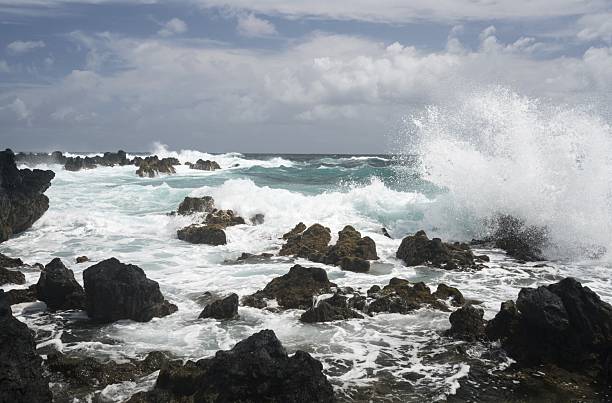
Peahi sits off a rugged coastline, its wave breaking over a deep-water reef that turns North Pacific swells into towering walls of water. On an average day, the bay can look almost sleepy. Then a powerful winter storm forms thousands of miles away, and the swell travels across the ocean with nothing to slow it down. When it reaches Peahi, the reef lifts it, focuses it, and throws it upward. Waves can reach twenty, forty, even sixty feet or more. The sound is like thunder rolled into a single crack. From the cliffs, the surfers look tiny, specks of color on a moving mountain.
The history of big-wave surfing at Peahi is a story of local imagination and courage. In the 1970s and 1980s, a handful of Maui surfers began to look at the break differently. It was too fast and too large for ordinary equipment, so they adapted. Tow-in surfing, with a jet ski towing a surfer into the wave, helped unlock Jaws for a new generation. Later, paddle-in surfing returned, proving that with the right board, training, and nerve, a person could catch these waves under their own power. Names like Laird Hamilton and Dave Kalama helped put Peahi on the map, but the wave has always belonged to the ocean first.
What makes Jaws different is not only its size but its texture. The wave moves fast, jacking up on the reef and racing across a playing field that shifts with every swell. There are currents that pull, foam balls that blind, and wipeouts that hold a surfer under long enough to make peace with the deep. Big-wave surfers train for years. They practice breath-holding, cardio, and ocean safety. They rely on spotters, jet ski drivers, and rescue teams. They wear impact vests and inflatable safety devices. They study forecasts the way climbers study weather. The best are not reckless. They are precise, patient, and humble. That humility is the heart of surf culture at Peahi.
For visitors, the appeal of Jaws is understandable. A giant swell is one of the most spectacular shows on Earth. But watching is not the same as entering. The cliffs near Peahi are not a stadium. There are no railings, no snack bars, no guaranteed parking. The ground can be muddy and slippery. The edge is crumbly. Waves can send spray and debris high into the air. If you go, go with respect. Park legally. Stay back from the edge. Never turn your back on the ocean. Bring binoculars, not bravado. Remember that local residents live here year-round. Their quiet roads are not a race track, and their patience is not unlimited.
The best time to hope for a Jaws swell is during Hawaii’s winter, roughly November through March, when North Pacific storms are most active. But no forecast can promise a show. Swells can arrive at night, fade before noon, or angle in a way that closes the wave. That uncertainty is part of the experience. It teaches patience. It also rewards those who plan carefully, check conditions, and understand that the ocean keeps its own schedule. If you are not a trained big-wave surfer, the right choice is to watch from a safe distance with a local guide, or to enjoy the many other breaks and beaches Maui offers.
Peahi is more than a surf spot. It is a symbol of Maui’s wild north shore, a meeting place for courage and technology, tradition and modern big-wave pursuit. It draws the world’s best athletes, but it also belongs to the people who grew up in its shadow and to the natural forces that created it. To stand on the cliff and watch a set arrive is to feel small in the best way. To see a surfer drop into a wave the size of a building is to understand why people dedicate their lives to the sea. Jaws does not care about your vacation itinerary. It only asks for respect. And in return, it offers a memory that stays long after the salt has dried.