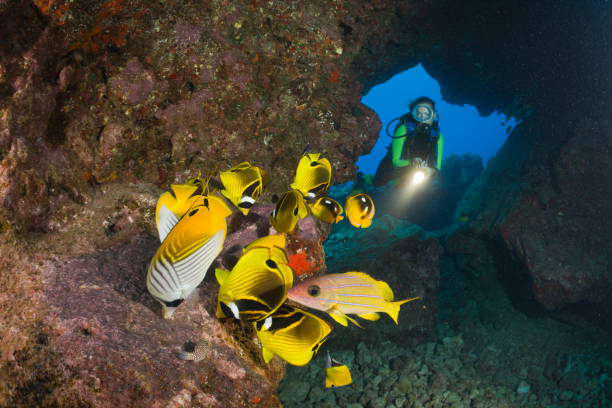
When the sun sinks behind Lanai and the last snorkelers leave the beach, Maui’s underwater world does not go to sleep. It changes shifts. Daytime fish find crevices to rest, while hunters, scavengers, and creatures of camouflage emerge from coral and lava. For certified scuba divers, a night dive around Maui can feel like visiting a completely different island. The reef that looked familiar by daylight becomes a landscape of shadows, tiny flashes, and sudden movement. Your beam becomes a portal, revealing eyeshine in a hole, a Spanish dancer nudibranch unrolling like ribbon, or an octopus flowing across the sand with impossible grace. It is the same reef, yet your senses are tuned to a different frequency.
Maui’s night diving is often done as a shore dive, which makes it accessible for divers who want adventure without a full day on a boat. Mala Wharf in Lahaina is one of the most popular and reliable night dive sites. The ruined pier creates a maze of pilings, rubble, and coral growth. By day it is busy with turtles and schools of fish. After dark, it becomes a nursery and hunting ground. You might see sleeping green sea turtles tucked under ledges, a spotted eagle ray gliding past, or a snowflake moray eel weaving through the rocks. The shallow depth and easy entry make it a good choice for divers who are new to night diving but comfortable in the water.
Black Rock, also known as Ka’anapali Beach, offers another classic night dive when conditions allow. The lava point drops into sandy channels and coral heads, and at night the contrast between bright beam and black water is thrilling. Divers often encounter octopus, reef squid, and sleeping parrotfish inside their mucous cocoons. If you have ever wondered where all the lobster go during the day, night diving answers that question. Spiny lobsters and slipper lobsters roam more openly after dark, their antennae probing the reef. Hunting behavior is on display everywhere: eels slither from their holes, crabs pick across rubble, and small shrimp reflect your light like scattered sparks.
Wailea Point and other south Maui sites can also be rewarding after sunset, though they demand good buoyancy and careful navigation. The reef is not lit, and the surface may be black except for distant hotel lights. A good night dive begins before you enter the water. You need a reliable primary light, a backup light, and ideally a tank light or glow stick so your buddy can see you from behind. Review hand signals for “look here,“ “turn around,“ and “out of air” before the dive. Stay close to your buddy, agree on a maximum depth and turn pressure, and keep your light beam from blinding others. Many Maui dive operators offer guided night dives, which are an excellent choice if you are new to night diving or unfamiliar with local conditions. They know where marine life tends to appear and how to read changing currents, swell, and visibility.
What makes night diving around Maui so memorable is not just the animals but the intimacy. Without the wide blue backdrop of day, your attention narrows to what your light touches. A single coral head can hold a drama: a brittle star curling, a hermit crab dragging its shell, a pair of shrimp sharing a sponge. You may hear sounds more clearly, too, from the crackle of snapping shrimp to the low hum of your regulator. When you finally switch off your light and wave your hand, bioluminescence may glitter like underwater fireflies. That moment, floating in warm Hawaiian water beneath a sky of stars, is why divers return to Maui again and again.
If you are dreaming of your first Maui night dive, plan it after you have refreshed your skills and logged a few daytime dives. Check ocean conditions, choose a reputable guide, and respect the reef by keeping a neutral buoyancy and never touching coral. Bring a warm rash guard or thin wetsuit, since evenings can feel cooler after multiple dives. Most of all, arrive curious. The ocean after dark is not empty; it is simply waiting for your light to reveal its next secret.