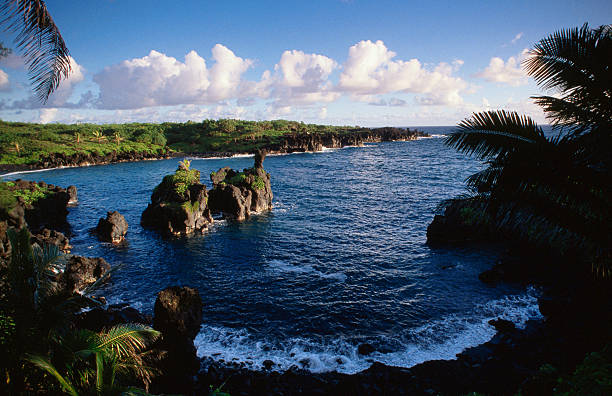
South Maui hiking often surprises people who think Maui is all resort beaches. At the island’s southern tip, the Hoapili Trail follows an ancient Hawaiian footpath across black lava fields. The route is rugged, exposed, and beautiful, with ocean spray, tide pools, and coconut palms. There is little shade. Start early, wear sturdy shoes, and carry more water than you think you need. The lava is sharp and uneven, and the sun reflects off the rock with surprising force. Treat cultural sites with respect; this is a living landscape, not just a scenic backdrop.
Nearby, Makena and La Perouse offer coastal walks where winter whales spout offshore and kayakers paddle clear water. The trails here are not manicured. They ask for attention, balance, and a willingness to slow down. If you go in the afternoon, trade winds can pick up, and the heat can feel intense. A sunrise hike or a late-day walk with softer light is often more comfortable. The reward is a raw South Maui experience: lava, ocean, and sky in every direction.
Drive a short distance up the slopes, and the world changes. Upcountry Maui is cooler, greener, and often wrapped in mist. Makawao Forest Reserve feels like a hidden pocket of the Pacific Northwest, with tall pines, eucalyptus, and ferns. The forest trails are gentle enough for families yet interesting enough for trail runners and mountain bikers. After rain, the paths can be slick and muddy, so waterproof shoes and a light rain jacket help. Birds call from the canopy, and the scent of eucalyptus follows you through the trees.
Higher still, Kula Forest Reserve and Polipoli Spring State Recreation Area offer a strange and beautiful mix of redwood, cypress, and fog. At this elevation, weather can shift from sunny to cold and windy in minutes. Trails wind through forest and open ridges with views toward the West Maui Mountains and the ocean far below. Check local conditions and hunting schedules before you go, and bring layers even if Kihei is hot. The contrast between South Maui’s lava and Upcountry’s cloud forest is one of the island’s great pleasures.
Then there is Haleakala itself. Within Haleakala National Park, trails like Hosmer Grove, Halemau’u, and Sliding Sands introduce you to a high-altitude world of native shrubs, cinder desert, and sweeping crater views. Hosmer Grove is an easy nature loop and a good place to look for native birds such as the i’iwi and apapane. Halemau’u Trail drops over the crater rim with dramatic switchbacks, while Sliding Sands descends into a vast volcanic basin that feels almost otherworldly. Altitude is real here. Drink water, move slowly, and turn around if you feel dizzy or short of breath.
The beauty of hiking South Maui and Upcountry is the range it gives you. You can begin the day near sea level, watching waves crash against lava, and end it in a chilly cloud forest or above the clouds on Haleakala. That variety is why Maui feels so alive. It is not one landscape but many, stacked from shoreline to summit.
Planning makes these trails safer and more enjoyable. Carry water, snacks, sun protection, and a rain shell. Wear shoes with good tread. Check weather and trail conditions. Stay on marked paths, avoid shortcutting switchbacks, and pack out everything you bring. Give native plants and animals space, and never disturb cultural or archaeological sites. If you are new to altitude, save summit hikes for later in your trip and give yourself time to adjust.
Whether you are a frequent visitor or dreaming of your first trip, these trails offer a deeper way to know Maui. They lead through lava and forest, heat and mist, ocean air and high-altitude silence. Take your time. Listen. The island rewards curiosity, preparation, and respect. On South Maui and Upcountry trails, every mile tells a different story of Haleakala’s influence, from the dry coast below to the cool slopes above.