Maui looks small on a map, but its roads tell a different story. The island is shaped by two volcanoes, Haleakala and Mauna Kahalawai, joined by a broad central valley. A drive from Kahului Airport to Wailea can take half an hour, while the famous road to Hana can take three hours or more, depending on weather, traffic, and how often you stop for banana bread. Understanding how to arrive on Maui and move around once you are there is one of the most practical keys to a smooth, memorable trip.
Most travelers fly into Kahului Airport, the island’s main gateway, with daily flights from the West Coast and interisland connections from Honolulu. Smaller airports in Kapalua and Hana serve limited flights, but Kahului is where nearly everyone begins. From the moment you land, you face a choice: rely on tours, shuttles, and public transit, or rent a car and explore on your own schedule. For most visitors, a rental car is the difference between seeing Maui and truly experiencing it. The island’s beauty is scattered across distinct regions, and while the Maui Bus connects many towns affordably, it is not designed for beach-hopping with coolers, snorkel gear, and sandy kids. Rideshare works in central, south, and west Maui, but can be scarce in Hana, Upcountry, and remote valleys.
Driving on Maui requires a shift in mindset. Speed limits are low, highways are often two lanes, and one-lane bridges are common. Locals commute these roads every day, so patience matters more than pace. The polite habit is simple: wave, yield, and do not tailgate. When you see a line of cars behind you on a winding road, pull over at a safe turnout and let them pass. This is not just courtesy; it is part of the island’s rhythm, sometimes called island time. You will enjoy the trip more if you stop trying to beat the GPS estimate.
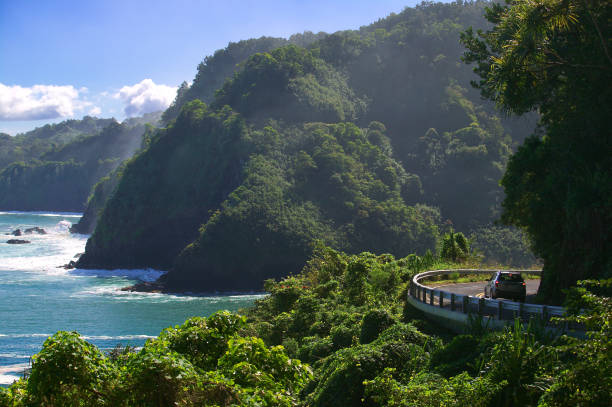
The Road to Hana is the classic example. It is not a highway to conquer but a journey to savor. With hundreds of curves and dozens of bridges, many of them one-lane, the drive demands attention. Start early, fuel up in Paia, carry water and snacks, and respect private property signs. Waterfalls and swimming spots may be on private land or closed for safety. The same goes for heiau, ancient temples, and other cultural sites. These are not photo backdrops; they are living places with history. Learning a few Hawaiian words and place-name meanings can deepen the drive. Hana itself is a small, proud community, not a theme park. Support local food stands and shops, take your trash with you, and leave every place as you found it.
Beyond Hana, Maui’s roads reveal other worlds. Upcountry Maui climbs through paniolo country, where Hawaiian cowboys have worked ranches for generations. Towns like Makawao and Kula offer cool air, farm stands, and views stretching across the central valley. West Maui leads to Lahaina, Kaanapali, and Kapalua, but the northern route around the island, often called the Kahekili Highway, is narrow, cliff-hugging, and not for everyone. Check your rental car agreement before driving it. The back road around Haleakala, the Piilani Highway, can be rough, remote, and occasionally closed. These routes are adventures, not shortcuts.
Guided tours can be a smart alternative. Companies handle the Road to Hana, Haleakala sunrise, snorkeling at Molokini, and even bike rides down the volcano. This lets you look at the scenery instead of the center line. If you stay in a resort and plan mostly to relax, you may not need a car every day. But if you want to chase hidden beaches, taste fresh fish in Kihei, watch sunrise above the clouds, and drive home under a sky full of stars, a rental car gives you the freedom Maui rewards.
Book your car early, especially during winter and summer peak seasons. Choose a size that fits your luggage and comfort, but remember that smaller cars handle tight parking and narrow roads more easily. Keep your tank full, download offline maps, and allow extra time for rain, traffic, and spontaneous stops. Getting to Maui is usually easy. Getting around with respect, curiosity, and patience is what turns a vacation into a genuine island experience.