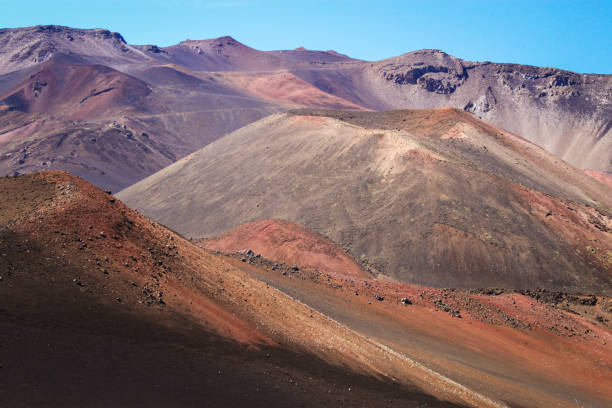
Haleakala is often called a crater, but that single word barely hints at the complexity of its summit. The vast depression at the top of East Maui is better understood as a broad basin shaped by erosion and later punctuated by eruptions. From its rim at sunrise, the landscape feels lunar, yet unmistakably Hawaiian. The floor is studded with reddish cinder cones, dark lava flows, and ash-covered slopes. Hiking into this high-altitude wonder, especially along the Sliding Sands Trail, is like walking through an open-air museum of volcanic geology. Each ridge, hollow, and black rock tells part of the story of how Maui was built, torn down, and built again.
Haleakala itself is a shield volcano, a mountain formed by countless fluid lava flows that stacked layer upon layer over hundreds of thousands of years. Its broad, gently sloping profile is classic for Hawaiian volcanoes. The summit stands more than ten thousand feet above sea level, high enough to catch frost, rare snow, and powerful winds. Radiating from the summit are rift zones, weak zones in the volcano’s flanks where magma has repeatedly risen and spilled out. These rift zones helped create the long ridges and peninsulas that give East Maui its distinctive shape. When you drive or hike across the island, you are often traveling over the hardened remains of ancient eruptions.
The most eye-catching features in the summit basin are the cinder cones. These steep, cone-shaped hills form when gas-rich magma erupts explosively, throwing ash, cinders, and volcanic bombs into the air. As the debris falls back around the vent, it piles up into a cone. In Haleakala, cinder cones such as Pu’u o Maui, Pu’u o Pele, and Ka Lu’u o ka O’o rise from the crater floor in shades of red, black, and gray. Some are young enough to still look fresh, while others are softened by erosion. Hikers can climb a few of them for sweeping views, but these formations are fragile. Staying on established trails helps protect them for future generations.
Lava flows are the other great builders of Haleakala’s landforms. Depending on how the lava cooled, it became either pahoehoe or a’a. Pahoehoe is smooth, ropy, and often undulating, while a’a is rough, jagged, and clinker-filled. Both types appear throughout the summit and along the volcano’s flanks. Where lava flowed in channels, it sometimes crusted over while molten rock continued to move beneath. When the eruption stopped and the lava drained away, it left behind a lava tube. The Hana Lava Tube, also known as Ka’eleku Caverns, is a remarkable example on Haleakala’s rainy windward slope. Inside, visitors can see lava stalactites, flow lines, and the smooth walls left by moving molten rock. These tubes are not just geologic curiosities; they can also channel groundwater and offer shelter to native species.
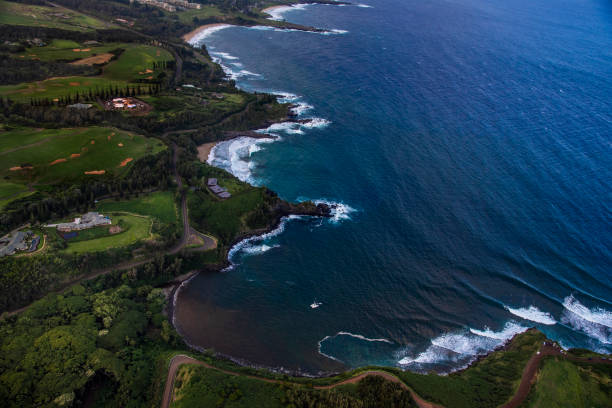
Water, wind, and time have carved Haleakala as surely as fire once built it. The summit depression is often called a crater, but it is not a single volcanic crater. It is a large basin that was deepened and widened by erosion, then partly refilled and decorated by later eruptions. Rain and frost break down volcanic rock into soil and ash. Streams on the windward side have cut deep valleys through the volcano’s flanks, while the leeward side remains drier and more barren. This contrast creates a remarkable range of landforms, from misty rainforest gullies to stark cinder fields. Along the coast, waves erode lava cliffs and sometimes grind volcanic rock into black sand beaches.
For hikers, these volcanic landforms are not just scenery. They shape every step. The Sliding Sands Trail descends through loose ash and cinder, giving the strange sensation of walking down a slope of crushed volcanic glass. The Halemau’u Trail drops over a cliff face with switchbacks and panoramic views. Longer routes like the Kaupo Trail trace old lava flows and erosion channels toward the sea. The substrate matters to plants, too. The rare silversword, or ahinahina, grows on cinder and ash in the summit area, its silver hairs reflecting harsh sunlight. Nene geese sometimes graze in these high-elevation habitats. Geology and ecology are woven together here; the rock determines where life can take root.
Understanding Haleakala’s volcanic landforms deepens every visit. A cinder cone is no longer just a colorful hill, but a record of explosive energy. A lava tube is not simply a cave, but a memory of moving rivers of stone. The summit basin becomes a story of collapse, erosion, and renewal. Whether you watch the sun rise from the rim or walk across the crater floor, you are stepping on the fiery origins of Maui. The island may feel timeless, but it is still changing, slowly and powerfully, one eruption, one rainstorm, one wave at a time.