Haleakala is often described as a dormant volcano, but the word dormant can make it sound sleepy, almost retired. Standing on its summit at sunrise, watching shadows pour across a basin of cinder cones and lava flows, you realize this landscape is not sleepy at all. It is a record of immense energy, followed by millions of years of wind, rain, and time. The mountain’s Hawaiian name means “house of the sun,” and from the top, where the sun seems to rise through a doorway of cloud and rock, the name feels less poetic and more literal.
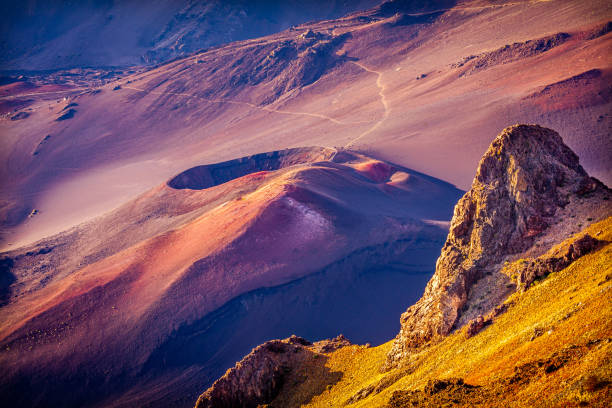
Haleakala is a shield volcano, built from countless overlapping flows of fluid basalt lava. Unlike the steep, cone-shaped volcanoes of the Cascades or the explosive peaks of the Aleutians, a shield volcano grows in broad, gentle layers. Each eruption sends lava outward in thin sheets that cool, harden, and make the island a little wider. Over time, those layers stack into a massive dome. The summit area we see today is not a single classic crater. It is a depression formed largely by erosion, with later eruptions punctuating the floor. That distinction matters: Haleakala’s “crater” is more accurately a valley-like erosion basin, a bowl carved by water and time, then decorated with young volcanic features.
For travelers, that geology becomes a treasure hunt. Along the summit road, you can see cinder cones—small, reddish or black hills formed when lava fountains threw fragments of molten rock into the air. These fragments cooled and fell as cinders, building cones around their vents. Some are bare and recent; others are softened by grass and shrubs. Lava flows appear as dark ribbons across the basin, some ropy and smooth, some rough and clinkery. If you hike the Sliding Sands Trail into the basin, the ground underfoot is often loose volcanic ash and cinder, a reminder that this is not ordinary dirt but shattered lava and ash from earlier explosions.
Haleakala is considered dormant rather than extinct, which means it has erupted within the geologically recent past and could erupt again. Its youngest flows are roughly a few hundred years old, and they still look raw, with little soil and sparse vegetation. Geologists study these flows to understand how future eruptions might behave. For visitors, that rawness is part of the thrill: you are not looking at a fossil volcano but at a living system in pause. The mountain’s summit is also a place of intense erosion. Freeze-thaw cycles at high elevation crack rock, while rare storms send water rushing downslope. Over thousands of years, these forces have carved the basin’s steep walls and left layers of ash, cinder, and lava stacked like pages in a book.
The volcanic story is also written in the cliffs and valleys of Maui. Haleakala has rift zones—weak zones in the volcano where magma once pushed sideways, creating ridges and fractures. Eruptions along these rift zones helped shape the island’s eastern flanks. Today, rain has carved deep gullies into those slopes. On the windward side, trade winds drop moisture, and streams cut through old lava layers, exposing cross-sections of the mountain’s internal plumbing. On the drier leeward side, cinder cones and lava fields remain more visible, preserved by the lack of rainfall.
One of the most intimate ways to meet Haleakala’s geology is underground. Lava tubes formed when the surface of a lava flow cooled and hardened while molten lava continued to flow beneath it. When the eruption ended, the molten river drained away, leaving a tunnel. Some tubes on Haleakala are large enough to walk through, their ceilings marked by drip-like stalactites of cooled lava. They feel like secret corridors left by the mountain, cool and quiet after the roar that made them.
Above ground, the summit’s high-elevation landscape is a study in adaptation. Silverswords, those famous spiky plants, grow slowly in volcanic cinder and survive intense sun, frost, and wind. Their presence shows how life follows geology, finding footholds in ash and cracks. Hikers should remember that this environment is fragile. Staying on trails protects both the plants and the thin volcanic soils. It also keeps you safe, because cinder slopes can be steep and loose, and the summit’s weather can change from clear to cold and clouded within minutes.
For the traveler dreaming of Maui, Haleakala is more than a sunrise spot or a checkbox. It is a place to read the island’s deep history. The mountain tells of lava that built the land, water that sculpted it, and plants that learned to live on the results. Whether you drive to the summit, hike into the basin, or simply watch the clouds gather below you, you are looking at a volcano in its long conversation with time. The sun may be the star of Haleakala’s name, but the real story is the rock beneath your feet—a story of fire, erosion, and the slow, patient making of Maui.