At sunrise, Haleakala feels like a world apart: cold wind, volcanic rock, and a horizon stretching beyond Maui. But the summit is more than a sunrise destination. It is a geological story written in lava, ash, and erosion, and hiking through it is one of the best ways to understand how East Maui was built. From smooth pahoehoe to jagged a’a, every step offers a clue to the forces that shaped this island.
Haleakala is a shield volcano, not the steep cone many people imagine. Shield volcanoes are built by countless eruptions of fluid, basalt-rich lava that spreads outward in broad layers, creating gentle slopes over hundreds of thousands of years. Haleakala rises more than 10,000 feet above sea level, but its true height begins on the ocean floor. Like the other Hawaiian islands, it formed as the Pacific Plate moved slowly over a stationary hotspot. As the plate drifted northwest, new volcanoes emerged and older ones were carried away from the magma source. Haleakala is the younger, larger half of Maui, and its last eruption was only a few hundred years ago, geologically speaking.
The summit area often called the crater is actually an erosional depression, not a single volcanic crater. It began as a high dome, then was carved by water, wind, and perhaps glacial action during cooler periods. Later eruptions dotted the basin with cinder cones, spatter ramparts, and ash. Hiking down Sliding Sands Trail, you descend through reddish and dark gray cinder, passing cones with names like Ka Lu’u o ka ’O’o. The colors shift with the light: rust, charcoal, ochre, and lunar blue in the shadows. These cones remind you that Haleakala erupted from many vents across a broad summit and along rift zones reaching toward the sea.
Lava tubes add another chapter. When a river of lava develops a hardened crust, molten rock can keep flowing beneath it like water in a pipe. When the eruption ends, the lava drains and leaves a cave. In East Maui, places such as the Hana area preserve these tubes, some large enough to walk through. Above ground, the same flows create smooth pahoehoe, clinker-strewn a’a, and coastal lava benches. Near La Perouse Bay, the Hoapili Trail crosses a stark lava field that feels raw and recent. Waves crash against black rock, and heat radiates from the stones.
Water and wind have done as much sculpting as fire. Trade winds push moist air against Haleakala’s windward slopes, feeding rainforests in Kipahulu and along the Hana coast. Streams cut deep valleys and birth waterfalls. On the leeward side, the mountain casts a rain shadow, creating dry grasslands and lava fields around Makena and Kihei. The summit can freeze at night, and frost slowly cracks rock. Rain carves gullies and moves ash. The result is a mountain of contrasts: alpine desert at the top, cloud forest on the slopes, rainforest on the northeast, and dry lava coast on the southwest.
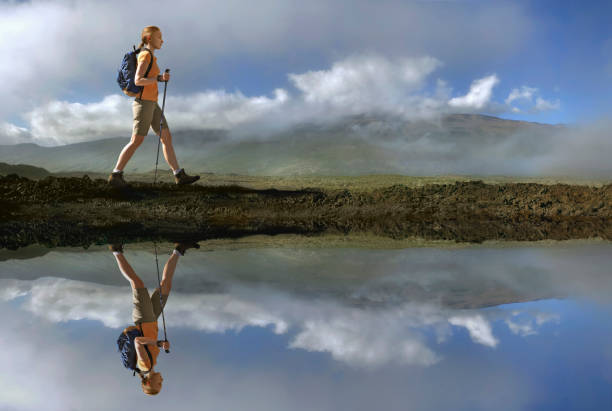
For hikers, these landforms are the trail. Sliding Sands descends into the summit basin, where silverswords rise like silver stars from cinder. Halemau’u Trail zigzags down the crater rim and connects with routes across the basin. Longer treks cross the depression and exit through Kaupo Gap, descending through climate zones toward the remote Kaupo coast. On the coast, trails like Hoapili follow ancient Hawaiian routes over lava. In Hana, lava tubes and black sand beaches show the same volcanic story from another angle. Each hike asks you to read the ground: Is this flow smooth or broken? Is this hill a cinder cone or an eroded remnant?
Planning matters. High altitude can surprise even fit travelers, so allow time to acclimatize, drink water, and bring layers. Weather changes quickly, and a sunny summit can turn cold and cloudy within minutes. Permits are required for some wilderness cabins and camping areas, and visitors should stay on trails, pack out trash, and avoid removing rocks or plants.
Understanding Haleakala’s volcanic geology turns a scenic drive or sunrise photo into a deeper experience. The mountain records eruption and erosion, creation and collapse, rain and fire. Whether you are dreaming of your first trip to Maui or returning for another hike, let the landforms be your guide. Walk slowly. Look closely. The story of Maui is under your feet.